

Responsible AI disclosure 👆
Generative Artificial Intelligence tools were used in the production of this work as stated here.
🚫 Ideation
✅ Research: technical literature [GPT-4]
🚫 Design
🚫 Copywriting
✅ Editing and proofing [GPT-4]
Working with marketers on AI, I make a couple of observations on repeat, and one is the assumption that the wave of Generative AI tools works almost entirely in the marketer’s favour. Even the more mature thinkers, knowing that the channels we use will evolve over time, see the future as doing more, better, faster.
There’s a radically different possible future in which AI agents, operated by disruptor tech companies or consumers themselves, leave brand marketers shouting into the void. You will need to re-think influence to come out on top.
Large Language Models and content.
One fundamental problem this wave of technology solves is output per effort unit. From brand-building thought leadership to SEO-optimised content marketing, from ads to sales outreach, your ability to output work product could be 10X.
This says nothing of the deluge of mis- and dis-information we are braced but not ready for. If you don’t care about politics, you might care that Google searches for basic exercise information now offer sometimes dangerously wrong advice on a soupy LLM-written page that’s 5x longer than it needs to be.
The opportunity of Generative AI for marketers does not exist in a vacuum.
In the short-term we accept that AI can help us do what we’ve been doing, but better. After all, people will still go to people and places they trust for help making purchase decisions and consumer behaviour will continue on-trend. But owing to poor experience, the curve of consumer trust may decline more quickly than good marketers are willing or able to adapt. Years ago, ad blockers came about because ads were, well, terrible.
If GenAI is a silver bullet for marketers, it could be a grenade for consumers
🎓 Definition: AI agent
An AI agent is a tool that performs a task on a user’s behalf, working in realtime and making decisions to reach its goal without much oversight, even across different technology surfaces. Tangibly, with enough trust and connected understanding of its user’s preferences, it could move meetings around, book a haircut, or one day make a purchase decision.
The standardisation of the web, big platforms and ad blockers all helped drive up the quality of peoples’ online experience and we found new ways of reaching people. A combination of consumer-first AI agents and platform evolution could be about to turn the table.

An early example of this is the newly-launched “Browse for me” search feature of The Browser Company’s Arc search.
It’s not great yet, but it’s only really bound by cost and training: it doesn’t know you well enough to do more than summarise your search results. It will not be long before this agent is a discovery engine that listens across my entire digital life, watching for patterns and building a profile that I, not a tech company, own and manage.
What an AI agent will look like in 12 months
The model will deliver the most relevant, personalised results through learning:
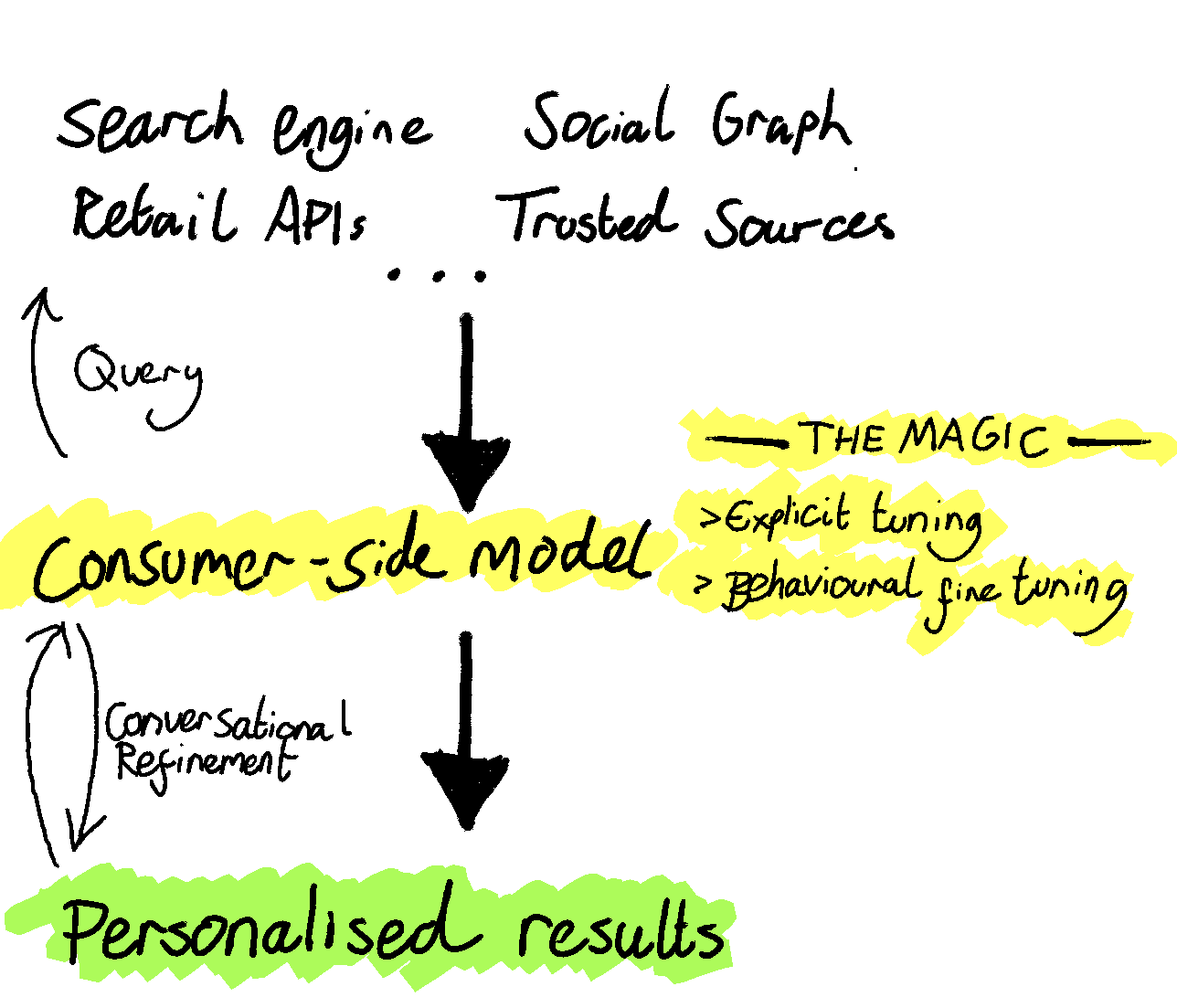
| Explicit tuning (app preferences) | Behavioural fine-tuning |
|---|---|
| User archetypes (e.g. deal hunter, researcher, on-trend buyer) | Signals from other apps (e.g. email opening behaviour, content signals, pre-purchase behaviour) |
| Trusted sources | Brand affinity |
| Consumer values (e.g. sustainability) | Promotions (from personalised sources) |
| Preferred brands and blacklist | Purchase history |
| Sale alerts and discount codes | Peer behaviour |
What comes next is App, Browser, Consumer Agent
Look to Google, who have been ranking search results and battling low-quality since day 1. Poor content threatens its search business, but presents a new opportunity in generative search. Google has incentive to invite brands into the experience through paid search, but does anybody else?
Countless AI-enabled services launch every day with no interest in maintaining the status quo. And importantly, more AI computation will soon happen on-device, lowering our dependency on big platforms to tell us what information is most relevant to our need.

Now consider Apple with its enormous reach, whose determination that the likes of Google and Meta had too much power upset the balance of the ad-supported internet almost overnight. What Apple really wanted was a share of the pie.
Why this might worry a marketer
Google et al will still be anxious rivals for years to come, even if their offerings look very different. But more accessible tech means the space will get more fragmented, and on-device models might mean an influence black hole: your audience, either intentionally or by virtue of the logo on their phone, might then never hope to see your message. Your thoughtfully personalised email, wonderfully creative ads, meticulously SEO-optimised content will suddenly count for much less.
My agent, knowing my loyalties, style preferences and values, and capable of replicating all my product research and obsessive bargain-hunting, would remove a lot of your influence over my decision. At least as we currently understand what influence.
The winning strategy: simpler than it appears?
Expect to see the existing eCommerce giants - Google, Amazon(!), TikTok, make plays here, which will offer paid promotion opportunities. But I've outlined a much bigger challenge.
The winning strategy is the same fundamental thing we’ve known for decades, but find difficult to put into action: build trust and demonstrate respect. However the environment changes, the winning mindset is constant:
- Communicate as humans.
- Lean further into influencers and creators.
- Be seen as more than a product, but an advocate for your market’s needs and values.
- Offer more value. Some brands do this through community, some through entertainment, and others delight and surprise with their service.
- Use your brand voice carefully and sparingly. The temptation of Generative AI is more stuff, faster.
- Earn influence and respect it when you have it. If you’ve earned your place at the top of my algorithm-ranked email inbox, just one or two junky emails could get you the chop. Worse, my AI agent might consider that a signal that I won’t care about your products next time I search the web.